
White spots on freshly washed glasses, stiff towels, dry-feeling skin, and a crusty buildup around faucets can all point to hard water. If you are figuring out how to select a water softener, the right answer is not simply choosing the biggest tank or the lowest advertised price. It starts with your home’s actual water conditions, your household’s water use, and the results you want from a system.
For homeowners in Palm Beach County, a properly selected softener can help reduce mineral scale in plumbing, water heaters, dishwashers, and fixtures while making everyday water feel more comfortable. The key is choosing equipment designed for your water, not a one-size-fits-all package.
Start With a Water Test, Not a Guess
Hard water contains dissolved minerals, mainly calcium and magnesium. Water hardness is usually measured in grains per gallon, often shortened to GPG. The higher the number, the more mineral content your softener needs to handle.
A water test should be your first step because hardness is only one part of the picture. Your water may also contain chlorine, sediment, iron, sulfur odor, or other concerns that a standard softener is not designed to solve. Municipal water in areas such as West Palm Beach, Jupiter, and Boca Raton may have different treatment needs than private well water, even when two homes are only a few miles apart.
A useful test looks at hardness and checks for conditions that affect equipment selection. For example, iron can foul softening resin over time, while chlorine can shorten the life of some resin types. If your water has a noticeable chlorine taste or odor, a whole-home carbon filter may make sense alongside the softener.
How to Select a Water Softener Based on Size
The most common buying mistake is choosing a system based only on the number of people in the house. Household size matters, but water hardness and daily water use matter just as much.
A family of four typically uses more water than a couple, but habits can change the calculation. Frequent laundry, large soaking tubs, multiple bathrooms, irrigation connections, visiting family, and teenagers taking long showers all increase demand. A professional recommendation should account for real household usage rather than relying on a generic chart.
Understand grain capacity
A softener’s grain capacity describes how much hardness it can remove before it needs to regenerate. Regeneration is the cleaning cycle in which the system uses water and salt to rinse collected minerals from the resin.
Larger capacity is not automatically better. An oversized system may cost more upfront and can be inefficient if it regenerates poorly for your household’s use. An undersized system may regenerate too often, use more salt and water than necessary, and allow hard water to return before the cycle is complete.
For most single-family homes, the goal is a system that has enough resin capacity to handle normal demand efficiently without forcing constant regeneration. The right size depends on test results, household size, plumbing flow rate, and any iron or unusually high hardness in the water.
Consider flow rate, not just capacity
Capacity tells you how much hardness the system can remove over time. Flow rate tells you how well it can keep up when several fixtures are running at once.
If someone is showering while the dishwasher and washing machine are running, a softener with inadequate flow can create a pressure drop. Homes with multiple bathrooms, rain-style showerheads, or larger families should pay particular attention to this detail. A good system should support comfortable water pressure during normal busy times.
Choose the Right Type of Water Treatment
Not every product marketed for hard water performs the same job. Knowing the difference protects you from paying for a solution that does not match your expectations.
A traditional ion-exchange water softener uses resin and salt to remove hardness minerals from the water. This is the best fit when your goal is to reduce scale, improve soap performance, and protect appliances from calcium and magnesium buildup.
Salt-free conditioners are different. They may alter how minerals behave and can help reduce some scale formation in certain applications, but they do not remove hardness minerals in the same way as a true softener. They are worth discussing if avoiding salt is your top priority, but they should not be presented as identical to a conventional water softener.
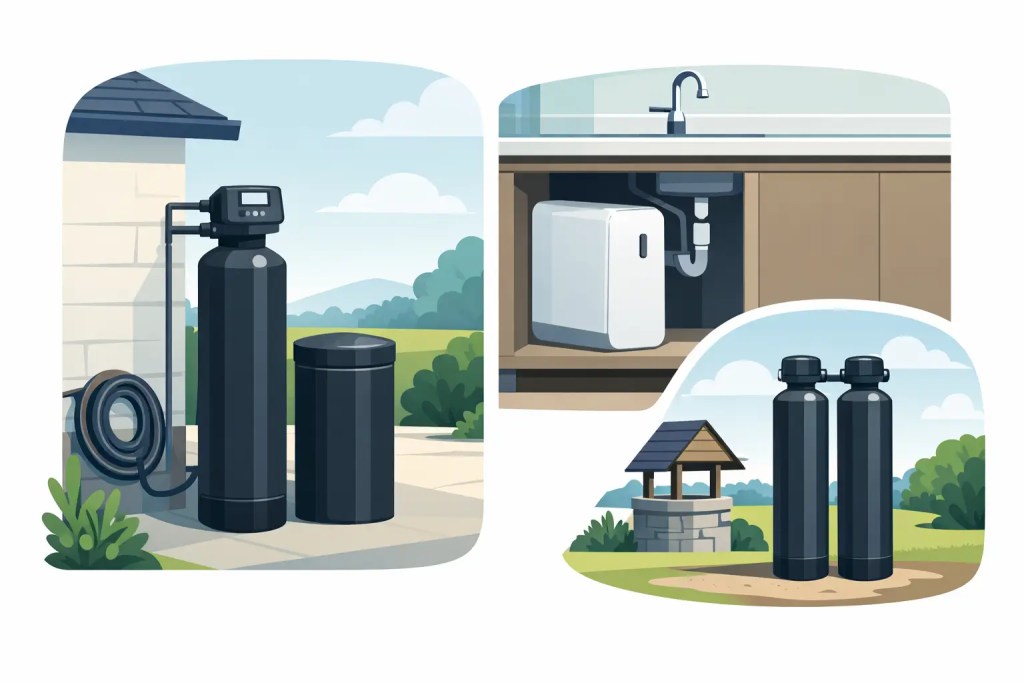
Many homes benefit from a combined approach. A whole-home carbon filter can reduce chlorine, unpleasant taste, and odor, while the softener manages hardness. For drinking water, a reverse osmosis system at the kitchen sink can provide another level of treatment for the water you consume. These systems have different roles, so a clear recommendation should explain what each component is meant to address.
Look Closely at Regeneration Features
Modern softeners should regenerate based on actual water use whenever possible. This is often called demand-initiated regeneration or metered regeneration. Instead of running on a fixed timer whether you need it or not, the system tracks water usage and regenerates when the resin capacity is nearly used.
This feature can reduce unnecessary salt and water use compared with older timer-based units. It also helps ensure the system is ready when your household needs it.
Ask whether the control valve is easy to program and whether it provides useful information, such as water use, regeneration history, or service alerts. A complicated controller is not necessarily a better controller. What matters is reliable operation and settings that match the home’s water conditions.
Compare Resin, Valves, and Certifications
A water softener is more than a tank and a brine container. Its long-term performance depends heavily on the resin inside the mineral tank and the control valve that manages each regeneration cycle.
Higher-quality resin is more durable and better suited to challenging water conditions. If chlorine is present in your water, chlorine-resistant resin may be a worthwhile upgrade. The control valve should be serviceable, dependable, and supported with available replacement parts. A lower initial price can become expensive if a proprietary valve is difficult to repair or the company cannot support it later.
Look for premium components and relevant NSF certifications. Certification does not replace proper sizing or installation, but it is one useful sign that equipment has been evaluated against established standards. Ask what components are certified and what the warranty covers, including the valve, tanks, and resin.
Plan for Installation and Ongoing Care
Before selecting equipment, confirm where it will be installed. A softener typically needs access to the main water line, a drain for regeneration discharge, and a nearby electrical outlet for the control valve. The location should also allow space to add salt and service the system comfortably.
Professional installation matters because bypass valves, drain connections, plumbing orientation, and programming all affect performance. The installer should protect your home’s plumbing, explain how the system works, and set it according to your tested water conditions.
Ongoing maintenance is usually straightforward. You will need to keep the brine tank supplied with the recommended salt and periodically check for salt bridging, a hardened layer that can prevent salt from dissolving properly. Depending on water quality and system design, resin cleaning or periodic service may also be recommended.
Think in Terms of Long-Term Value
The cheapest softener is not always the most affordable one over the years. Consider the full cost: equipment quality, installation, salt and water use, warranty coverage, service availability, and expected lifespan.
A properly sized, demand-initiated system can help control operating costs while protecting water-using appliances from hard-water scale. That can mean less time scrubbing fixtures, better-performing soap and detergent, and fewer mineral deposits on dishes and shower doors. Results vary by water conditions, but the right equipment should deliver practical improvements you can notice around the home.
Be cautious of offers that promise a softener will solve every water concern without a test. Honest recommendations explain what the system can do, what it cannot do, and whether filtration should be added for chlorine, sediment, or drinking-water concerns.
Questions Worth Asking Before You Buy
Before making a decision, ask for your hardness test result, the recommended grain capacity, expected regeneration frequency, and the reason that size fits your home. Ask whether the system uses demand-initiated regeneration, what type of resin and control valve it includes, and whether service will be available after installation.
Also ask for a clear explanation of warranty terms and ongoing maintenance. You should understand what you are purchasing before installation day, including whether a separate carbon filter or reverse osmosis system would better address other concerns in your water.
A water softener should make life easier, not create another household headache. Honest Water of the Palm Beaches can test your water, explain the findings in plain language, and help you choose a properly sized solution for your home and budget. A clear water test and a straightforward conversation are the best place to start.
