
A white film on clean dishes, dry-feeling skin after a shower, chlorine odor at the kitchen sink, or water that simply tastes off are all clues that your home may benefit from treatment. But knowing how to select water treatment is not about buying the biggest system or choosing the first filter you see. It starts with understanding what is actually in your water, where you want improvement, and what will serve your household reliably for years.
For Palm Beach County homeowners, the right answer is often a combination of whole-home filtration, softening, and dedicated drinking-water treatment. The right combination depends on your water conditions, household size, plumbing, and priorities.
Start With Your Water, Not a Product
Municipal water is treated before it reaches your home, but that does not mean every household has the same experience. Water can pick up sediment from pipes, retain a noticeable chlorine taste or smell, and carry minerals that create scale. Homes on private wells have a different set of considerations, including iron, sulfur odors, bacteria, hardness, or changes in water quality over time.
A proper water test gives you a starting point. It can identify concerns such as hardness, chlorine, total dissolved solids, pH, iron, sediment, and certain contaminants. If you are concerned about a specific issue, such as PFAS or lead, ask for testing that addresses that concern rather than assuming a general test covers it.
Your senses matter too. A test explains the chemistry, while your daily experience explains the impact. For example, hard water may show up as spotting on glassware, stiff laundry, soap that does not lather well, and buildup around faucets. Chlorine may be most obvious in the shower or in a glass of tap water. Those details help match the treatment to your goals.
Decide Where You Need Better Water
One of the most useful ways to select water treatment is to separate whole-home needs from drinking-water needs. A small pitcher filter may improve the taste of a few glasses of water, but it cannot protect a water heater, improve shower water, or reduce scale throughout the house.
Whole-home filtration
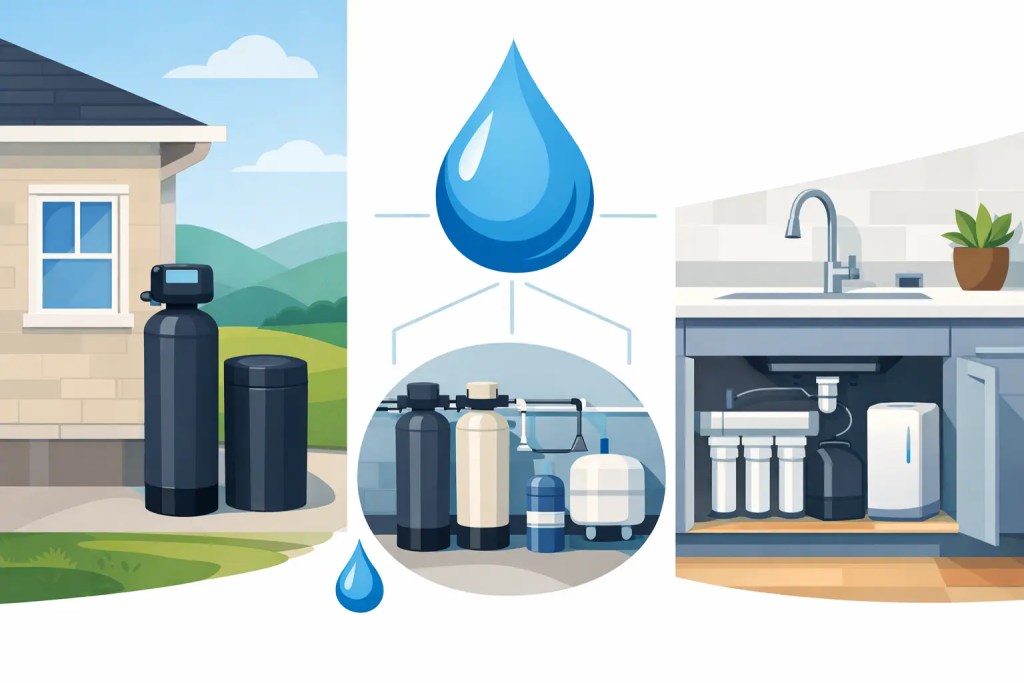
A whole-home filtration system is installed where water enters the house. It treats water used for showers, sinks, laundry, cooking, and appliances. Depending on the filtration media, these systems can reduce chlorine, sediment, unpleasant tastes and odors, and selected contaminants.
This approach makes sense when the concern affects more than the kitchen faucet. Families often choose whole-home filtration because they want better shower water, less chlorine odor, cleaner-feeling water throughout the home, and protection for plumbing fixtures.
Water softening
A water softener is designed specifically for hard water minerals, mainly calcium and magnesium. These minerals are not always easy to see in a glass, but they can leave scale inside pipes and water-using appliances. Over time, scale can reduce efficiency and make fixtures harder to clean.
A softener is often the best fit when testing confirms significant hardness and the household sees the familiar signs: cloudy dishes, crusty faucet aerators, dry-feeling hair, frequent soap scum, or shortened appliance life. It is not a replacement for a drinking-water filter, because softening and filtration do different jobs.
Reverse osmosis drinking water
A reverse osmosis, or RO, system is usually installed under the kitchen sink and provides highly filtered water at a dedicated faucet. It is a strong option for families who want better-tasting water for drinking, cooking, coffee, ice, and baby formula preparation.
RO systems can reduce many dissolved substances that a whole-home carbon filter may not target. They are especially useful when a homeowner wants an added level of treatment at the point of consumption. In many homes, a whole-home system and an RO system work well together: one improves the water everywhere, while the other focuses on the water you drink.
Match System Capacity to Your Household
A system that is too small can create pressure loss, run through filtration media faster than expected, or struggle during busy times of day. A system that is unnecessarily oversized may cost more without delivering a meaningful benefit. Capacity should be based on the number of people in the home, bathrooms, peak water use, water hardness, and plumbing flow rate.
Consider what happens on a typical morning. If two showers are running while someone starts laundry and another person fills a water bottle, your system needs to handle that demand without becoming a bottleneck. Larger homes in Jupiter, Wellington, or Palm Beach Gardens often need more than a basic one-size-fits-all setup.
For a softener, sizing also depends on hardness and daily water use. For filtration, the key questions include flow rate, media volume, and expected service life. An experienced water professional should explain these numbers in plain English and show why a particular size fits your home.
Look Beyond Marketing Claims
Water treatment equipment should be judged by what it is designed and certified to reduce, not by broad promises on a box. Look for reputable, NSF-certified components or systems when applicable. NSF standards help verify that a product has been independently evaluated for specific material safety or contaminant-reduction claims.
Certification does not mean every system treats every concern. A carbon filter may be excellent for chlorine and taste, while an RO membrane addresses a wider range of dissolved substances at the drinking-water tap. Ask which contaminants the system is intended to reduce and whether that matches your test results.
It is also reasonable to ask about the equipment inside the tank or housing. Quality resin in a softener, appropriate filtration media, durable valves, and properly sized connections all affect performance and longevity. You do not need to become a water treatment engineer, but you deserve a clear answer instead of a vague sales pitch.
Factor in Maintenance Before You Buy
Every water treatment system needs some level of care. The best choice is one your household can maintain comfortably and predictably.
A water softener typically needs salt added on a schedule that depends on water use and hardness. Whole-home filters may need media replacement after a set number of years or gallons. An RO system needs filter changes and periodic membrane replacement. None of this should be a surprise after installation.
Before choosing, ask who handles service, what replacement parts cost, how often maintenance is expected, and whether the company provides reminders or ongoing support. A lower upfront price can become less attractive if the system uses costly proprietary cartridges or if service is difficult to arrange.
Also ask what happens if your water conditions change. For example, a home that switches from municipal water to a well, or a family that adds household members, may need an adjustment. Good water treatment is not just a product purchase. It is a long-term plan for your home’s water.
Compare Total Value, Not Just the Installed Price
Price matters, and homeowners should be able to get straightforward answers about it. Still, the least expensive option is not always the best value when it treats only one symptom, requires frequent replacements, or does not fit the home’s water demand.
Compare the complete picture: testing, equipment quality, installation, warranty coverage, expected maintenance, local service, and the system’s ability to address your actual concerns. A properly designed whole-home solution may help reduce scale-related wear on fixtures and appliances while improving everyday comfort. An RO system may also reduce reliance on cases of bottled water for many households.
Be cautious with packages that sound identical for every home. Water treatment should be customized, but customization should also be transparent. You should understand what each component does, why it is recommended, and what you can reasonably expect from it.
Questions to Ask Before Choosing a Water Treatment Company
The company you choose matters as much as the equipment. Installation quality affects water pressure, bypass access, drainage, regeneration settings, and how easy the system is to service later.
Ask whether the recommendation is based on a water test, whether the installer will evaluate your plumbing and available space, and whether the quoted price includes everything needed for a working installation. It is also helpful to ask about warranties, service availability, and whether someone will walk you through operation after the system is installed.
A trustworthy provider should be comfortable explaining trade-offs. For instance, a whole-home carbon filter may be the right first step for noticeable chlorine, while a softener becomes essential when hard water is the larger issue. If drinking-water quality is your priority, an RO system may be the most targeted investment. Honest advice means recommending what fits, not adding equipment you do not need.
Choose a Plan That Fits Your Home and Family
The best water treatment system is the one built around real water conditions and real household habits. Start with testing, identify whether your concern is throughout the home or mainly at the tap, then compare systems based on performance, certifications, capacity, and long-term care.
If you are unsure where to begin, Honest Water of the Palm Beaches can help homeowners make sense of their water results and choose a practical solution without the guesswork. Cleaner, better-tasting water should feel like a confident home improvement decision, not a complicated one.
